Girth is the distance around something at its thickest point — the number a soft tape measure reads when you wrap it round and see where it meets itself. It’s the same thing your geometry teacher called circumference: tailors say girth, tree surgeons say girth, saddle makers say girth, maths textbooks say circumference. One measurement, two names, same tape. If you learn one word from this whole site, make it that one.
The reason we bang on about it: girth is the dimension that decides whether a toy is comfortable, challenging, or simply not happening. Length gets the attention in casual conversation, but your body accommodates girth continuously, along the whole insertable length, the whole time. It’s also the number nearly every maker publishes.
Girth, circumference, diameter and width — untangled
Three words for one circle, plus a fourth that causes most of the trouble:
- Girth — the distance around the thickest point. Identical to circumference. Measured with a tape or a piece of string.
- Circumference — the geometry-class word for exactly the same thing.
- Diameter — the distance straight across the same circle. You can’t measure it with a tape; you’d need calipers (or maths).
- Width — whatever the writer meant. In practice it usually stands in for diameter, but people use it for the around number too, and one of the more common questions in toy forums is some version of “girth vs width vs circumference — are these different things?”. They aren’t; the words are. Check which measurement a number is before you compare it to anything.
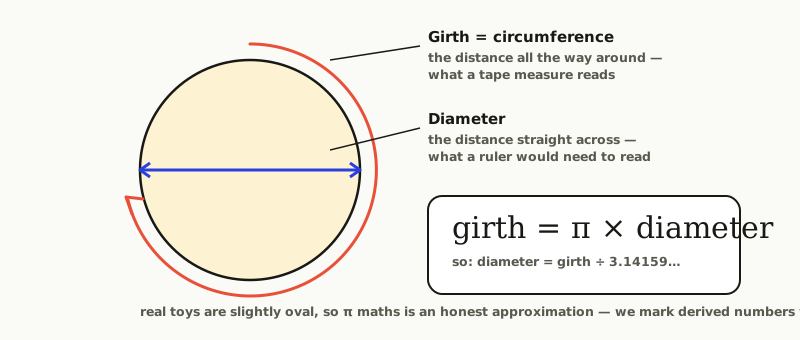
They’re locked together by one piece of ancient maths:
girth = π × diameter, so diameter = girth ÷ 3.14159…
A 5″ girth is about 1.59″ across. A 6″ girth is about 1.91″ across. A 7″ girth is about 2.23″ across. That’s the whole trick.
If you’d rather not do the division, that’s what our girth ↔ diameter ↔ circumference converter is for. It converts in all three units and draws the resulting circle life-size on your screen next to a bank card, which is worth a thousand decimal places.
Why do makers publish circumference instead of diameter?
Walk any indie maker’s spec sheets — including the four we track — and you’ll find circumference everywhere and diameter almost nowhere. The reason is practical:
- Anyone can check a circumference. Wrap a tape, read a number. A customer, a reviewer and the maker will all get the same answer.
- Diameter on a soft object is genuinely ambiguous. Squeeze calipers onto a squishy silicone toy and you’re measuring your grip strength as much as the toy.
- Toys aren’t perfect circles. Most are slightly oval in cross-section. An oval has many diameters, widest across and narrowest across, but still only one circumference.
That last point matters when you convert. Dividing by π assumes a perfect circle, so the derived diameter of a real toy is an approximation: the true widest-across of an oval shaft is usually a touch more than the maths says. Close enough to be useful, not close enough to be gospel, which is why every diameter we derive in the database carries a ~. Pleasure Forge, the one maker on our shelf who publishes both numbers, gives diameters that routinely disagree with naive π maths by a little, for exactly this reason.
Girth vs length: which should you compare?
Both, ideally. But if you’re only going to compare one number between two toys, compare girth. The hierarchy:
- Girth is felt everywhere, always. It sets the stretch, and stretch is what your body notices most. Half an inch of extra girth is a much bigger jump than half an inch of extra length.
- Length matters at the ends of the range. Too little insertable length and a toy can’t do its job; a lot of extra length has to go somewhere. In the comfortable middle, an inch either way changes surprisingly little.
- Girth interacts with firmness. The same 6″ around reads noticeably gentler in a soft pour than a firm one, because soft silicone deforms and shares the load. Our firmness explainer covers this properly, and it’s why the fit engine scores feel alongside the tape-measure numbers.
Girth is rarely one number per toy, either. A fantasy sculpt might be 4.5″ around at the tip, 6″ mid-shaft and 8″ at the knot, which is why our spec tables list girth at each named measuring point. When a product card shows a single girth, it’s the widest insertable point: the gatekeeper number.
What the numbers mean on a real shelf
These are bands and bodies differ, and firmness moves the goalposts. But as a map of the catalogue we actually track:
| Girth (around) | ~Diameter (across) | How the shelf reads it |
|---|---|---|
| under 4″ | under 1.3″ | slender — plugs, slim sculpts, warm-up territory |
| 4–5″ | 1.3–1.6″ | the gentle middle; most beginner recommendations live here |
| 5–6″ | 1.6–1.9″ | the crowded heart of most catalogues |
| 6–7″ | 1.9–2.2″ | genuinely thick; experience or patience required |
| 7–8″ | 2.2–2.5″ | challenge territory |
| 8″+ | 2.5″+ | specialist; approach with respect and a plan |
Every band is a live filter: under 4″, 4–5″, 5–6″, 6–7″, 7–8″, 8″ and up. If you don’t have a number to start from, the beginner sizing guide walks the whole decision.
The three-second conversion cheat
For tape-free moments: divide the girth by 3 and knock a little off to get the diameter. 6″ around → about 1.9″ across. It’s π-lite, and it lands within a few percent, which is enough to sanity-check a listing on the bus. For actual purchase decisions, use the converter and, better yet, measure something you already own so the numbers anchor to a feeling you know.